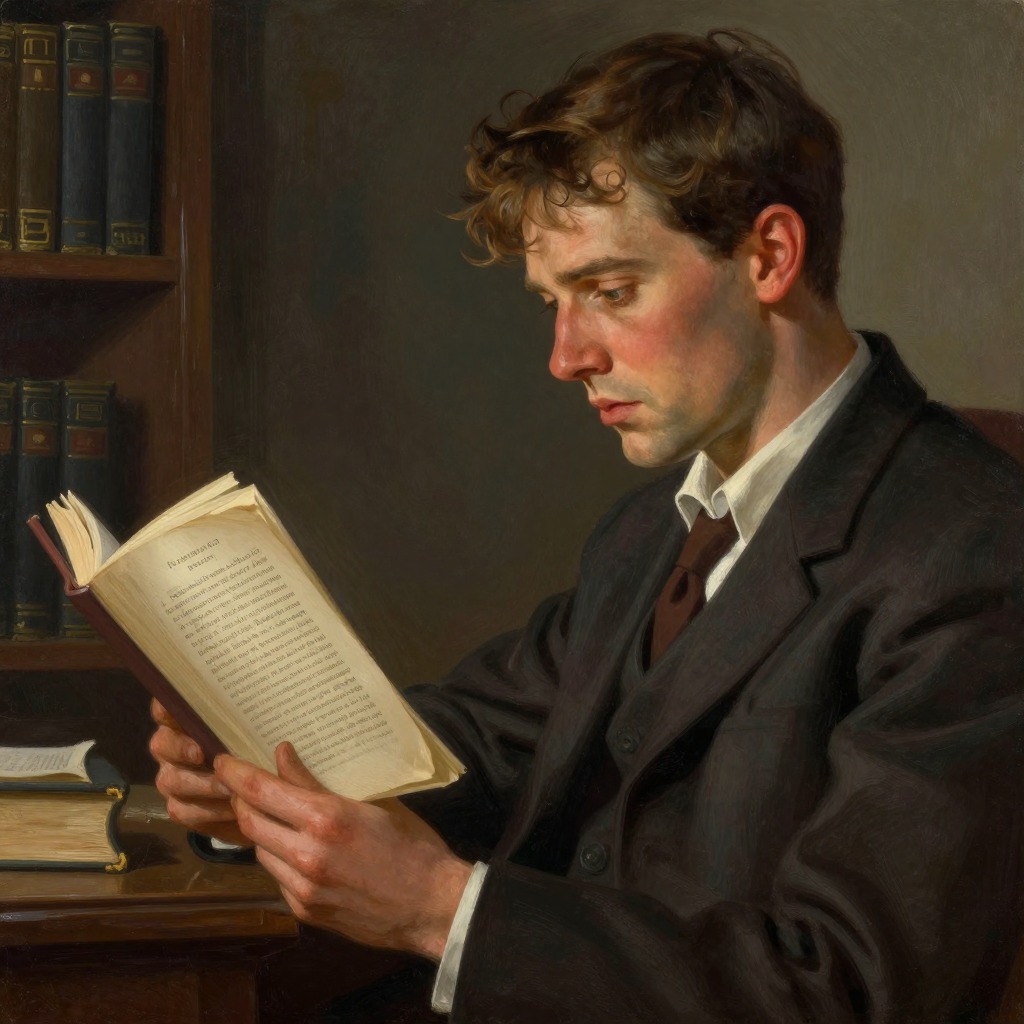
Time has fallen asleep in the afternoon sunshine
The line "Time has fallen asleep in the afternoon sunshine" appears in Fahrenheit 451 as a fragment of poetry that Montag catches sight of during the burning of an old woman's books. It is a single, fleeting image that blazes in his mind "as if stamped there with fiery steel," marking a moment of profound disruption in his consciousness. The line encapsulates the novel's central tension between the enforced, static contentment of a fireman's world and the restless, questioning life that books represent.
Appearance and Context
The line is first encountered in Part I, during the raid on the old woman's house. As Montag climbs the stairs, books "bombarded his shoulders, his arms, his upturned face." One book alights in his hands "almost obediently, like a white pigeon," and in the dim, wavering light, a page hangs open. Montag has only an instant to read a single line: "Time has fallen asleep in the afternoon sunshine." The phrase is immediately seared into his memory, and he drops the book, only to have another fall into his arms. This stolen glimpse is the first piece of literature Montag has ever truly seen, and it occurs in the midst of an act of destruction, surrounded by the chaos of the burning house and the old woman's defiant presence.
Thematic Significance
The line serves as a powerful metaphor for the society Montag inhabits. In a world where firemen burn books to enforce happiness and uniformity, time itself seems to have stopped. The "afternoon sunshine" suggests a perpetual, unchanging present, a state of suspended animation where no one questions, no one remembers, and no one grows. The phrase echoes the novel's critique of a culture that has traded depth for comfort, where the "parlour walls" and Seashell radios provide endless distraction but no real engagement. Montag's encounter with this line is a crack in that static world; it hints at a different kind of time—a time of reflection, of stillness that is not empty but full of potential meaning.
Connection to Montag's Awakening
The line is part of a chain of experiences that push Montag toward rebellion. Shortly after reading it, he reflects on the old woman who chose to burn with her books, and he tells Mildred, "There must be something in books, things we can't imagine, to make a woman stay in a burning house." The line "Time has fallen asleep" becomes a touchstone for his growing awareness that his life, and the life of his society, has been lived in a kind of trance. Later, when he confesses to Mildred that he feels "so damned unhappy" and that he "might even start reading books," he is articulating the awakening that began with that single line. The phrase also resonates with his later realization, after killing Beatty and fleeing the city, that he must "never burn again in his life"—that the sun itself burns time, and that someone must begin the work of saving and keeping.
Contrast with the Novel's Imagery
The line's gentle, pastoral quality stands in stark contrast to the novel's dominant imagery of fire, destruction, and speed. The "afternoon sunshine" suggests a world of leisure and contemplation, a world that has been deliberately erased by the firemen's culture of instant gratification and constant motion. Montag's own life, before meeting Clarisse, was one of mechanical routine: he "whistled, hands in pockets, walked across the upper floor of the fire station and fell down the hole." The line offers an alternative vision of time—one that is not rushed, not filled with noise, but still and receptive. It is a vision that Montag will eventually find realized in the campfire of the book people, where "time was there, time enough to sit by this rusting track under the trees, and look at the world and turn it over with the eyes."
Narrative Role and Evaluation
As a literary device, the line functions as a seed of poetry planted in Montag's mind, a fragment that he cannot fully understand but that haunts him. It is one of the few pieces of literature he directly encounters before his transformation, and its dreamlike quality mirrors the novel's own exploration of the boundary between waking and sleeping, between the "real" world of the parlour walls and the deeper reality of books. The line is never quoted again, but its effect lingers: it is part of the "saving up" Montag feels, the accumulation of experiences that finally breaks through his conditioned numbness. In the context of the novel's argument for the value of literature, "Time has fallen asleep in the afternoon sunshine" stands as a quiet, beautiful rebuke to a world that has chosen to forget how to be still.